
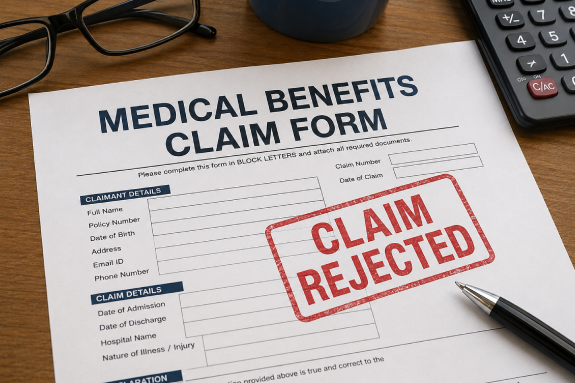
Not every rejected claim is the insurer’s fault. Learn the common policyholder mistakes that lead to claim rejection, and why avoiding small motor claims to protect your No Claim Bonus (NCB) can cost you more.
“Needless to say we are extremely satisfied with the results. Insurance is exactly what our business has been lacking. I don’t know what else to say. Insurance is awesome!”


Why Insurance Claims Get Rejected – And Why Skipping Small Motor Claims for NCB Can Backfire
Getting a claim rejection letter feels personal. The first instinct for most policyholders is to assume the insurance company acted in bad faith. But here’s an uncomfortable truth the industry doesn’t talk about enough: not every rejected claim is the insurer’s fault.
In a significant number of cases, the root cause traces back to decisions the policyholder made – often without realizing it – at the time of buying the policy, renewing it, or filing the claim itself. Understanding these patterns is the first step to protecting yourself, whether you’re dealing with a health policy, a motor policy, or anything in between.
- We can save you money.
- Production or trading of good
- Our life insurance is flexible.
- A fast & easy application
- Growing your business
The Four Most Common Reasons Claims Get Rejected
- Signing Without Reading the Terms & Conditions
Most policyholders sign proposal forms without going through the fine print – particularly exclusion clauses, waiting periods, and sub-limits. These clauses are legally binding the moment you sign, regardless of whether you read them. A claim that looks “obviously valid” to you may fall squarely under an exclusion you never noticed.
- Hiding Medical History or Critical Information
This is one of the most frequent reasons health and life insurance claims get denied. If a PED (Pre-Existing Disease) clause applies and you didn’t disclose a known condition at the time of purchase, the insurer can treat it as non-disclosure or misrepresentation – and reject the claim outright, sometimes even voiding the policy entirely. - Assuming Coverage Continues After a Lapse
Missing a premium payment and letting the grace period pass doesn’t just delay your coverage – it ends it. Many policyholders file claims assuming their policy is active, only to discover it lapsed months earlier. Once a policy lapses, any claim raised during that inactive period has no legal standing. - Late Intimation and Incomplete Documentation
Every policy has a defined claim intimation timeline. Informing the insurer late, or submitting incomplete or incorrect documents, is one of the most common – and most avoidable – reasons a TPA (Third Party Administrator) or insurer rejects a claim during processing.
So, Was Your Claim Rejection Actually Valid?
Before reacting with frustration, ask two questions:
a. Is the rejection consistent with the actual terms of your policy?
b.Or has the insurer made a decision that doesn’t hold up against those terms?
Not every rejected claim is unfair. But not every rejection is fair either. If your claim was denied on shaky or incorrect grounds, you have the right to challenge it – through a formal representation to the insurer, and if unresolved, escalation to the Insurance Ombudsman or IRDAI’s grievance redressal channel.
This is exactly where working with an experienced claims consultant makes a difference – someone who can independently assess whether a rejection is genuinely valid or worth contesting, rather than accepting the insurer’s word at face value.
The Motor Insurance Blind Spot: Skipping Small Claims to “Protect” NCB
A separate but equally common mistake happens specifically with motor insurance – and it isn’t about hiding information. It’s about avoiding legitimate claims altogether.
After a minor accident – a dent, a scratch, a cracked bumper – many vehicle owners decide not to file a claim at all, purely to protect their No Claim Bonus (NCB). NCB is a real and valuable discount, sometimes reducing your own-damage premium by up to 50% over several claim-free years. But this instinct, while understandable, isn’t always the financially smarter move.
Where This Habit Goes Wrong
Getting damage repaired privately, without an inspection. Surface-level damage can hide deeper issues in the chassis or suspension – problems that surface later as far more expensive repairs, uncovered by the policy since they were never documented.
Not comparing repair cost against the NCB discount. If the actual repair bill exceeds what you’d save by preserving your NCB slab, skipping the claim is a straightforward financial loss – not a saving.
Leaving damage unreported entirely. If a related, larger claim comes up later involving the same part of the vehicle, insurers can flag the earlier unreported damage and use it as grounds to dispute or reject the new claim.
Not opting for an NCB Protection add-on. For a relatively small additional premium, this add-on lets you make a limited number of claims without affecting your NCB slab – removing the dilemma altogether.
The Real Question to Ask
Every time you assess a motor insurance claim, the question isn’t “will this affect my NCB?” It’s: “Does the cost of not claiming outweigh the benefit of protecting my discount?” Sometimes the answer is yes – a very minor scratch may genuinely not be worth a claim. Other times, policyholders end up paying far more out of pocket than the NCB was ever worth.
The Common Thread
Whether it’s a health claim rejected over a technicality, or a motor claim never even filed out of NCB anxiety, the underlying issue is the same: most policyholders are making high-stakes insurance decisions without a clear, independent read on their own policy.
Insurance documents are written to be legally precise, not easy to understand. That gap is exactly where genuine claims get wrongly rejected, and where legitimate small claims go unfiled out of unnecessary caution.
Get an Independent, Expert Review Before You Decide
Whether you’re holding a rejection letter or wondering if a recent fender-bender is worth reporting, the safest move isn’t to guess – it’s to get a proper assessment of your specific policy and situation.
Expert Claim Solutions helps policyholders across health, life, motor, fire, and commercial insurance categories understand exactly where they stand – and fight for what’s rightfully owed when a rejection genuinely doesn’t hold up.


Leave a comment